

Project Background
For months, I was using various financial tracking apps to manage my personal finances. But among them, I didn't find one that fulfilled all my needs.
Project Goals
I wanted to validate a problem that I faced while using several financial trackers.
Aiming to design a product that would help users who were facing the same issues.
Expanding my experience beyond UI/UX design into product management and research.
User Targets
All backgrounds in the world (Urban & suburban hubs)
19 – 40 years old (Gen Z & Millennials)
The Challenge
Since it was only a personal project, which was a lower priority, I was struggling a little bit to manage the timeline around my main schedule.
The Strategy
Before diving into production, I mapped out the scope and established a timeline to keep my progress on track.
To inform my design process, I conducted foundational research by leveraging social media networks and gathering insights from close peers.
Responsibilities
I handled the entire product design scope, which involved product thinking, user research, feature definition, user flows, branding, UX architecture, and responsive UI design.
Result
In the end, I was able to validate the core problem and my design solutions through hands-on user research and usability testing, successfully driving the project from initial concept to a high-fidelity prototype.
PROBLEM STATEMENT
Questioning Myself

RESEARCH
Casual Interview
To validate whether these pain points were shared by others, I conducted informal interviews within my immediate circle. Using the affinity diagram below, I synthesized my observations, mapped out the core user problems, and brainstormed initial ideas to address them.

RESEARCH
Feature Discovery with Competitor Analysis
As part of my usual process, I conducted research through competitor analysis to uncover three main points:
Core and supporting features: Mapping out existing product capabilities.
Pros and cons: Evaluating the strengths and weaknesses of each platform.
User flow and interface design: Analyzing the overall user experience and visual layout.

IDEATION
Defining the MVP Features
Despite this being an exploratory project, I utilized the data gathered to prioritize features against my core product goals. By defining a clear MVP (Minimum Viable Product) scope now, the project is structured for a seamless transition to development if it ever goes live.

DESIGN SOLUTION
Design Guidelines & Components


DESIGN SOLUTION
Crafting & Improving
the User Interface
Along with the final UI, the screens below showcase iterations made directly from user feedback to validate the overall experience. Here I asked 3 users to try my high-fidelity prototype.
DESKTOP VERSION
Onboarding
Through this process, I want user to fill their initial data so that user could acknowledge the things that they could do within the product. Here, I got other perspective about this steps where user want to using the app quickly.

Dashboard
This screen allows users to monitor key metrics, including their total balance, cash flow summary, recent transactions, and budget activity. I also introduced a streak feature aimed at boosting user retention.

Transaction
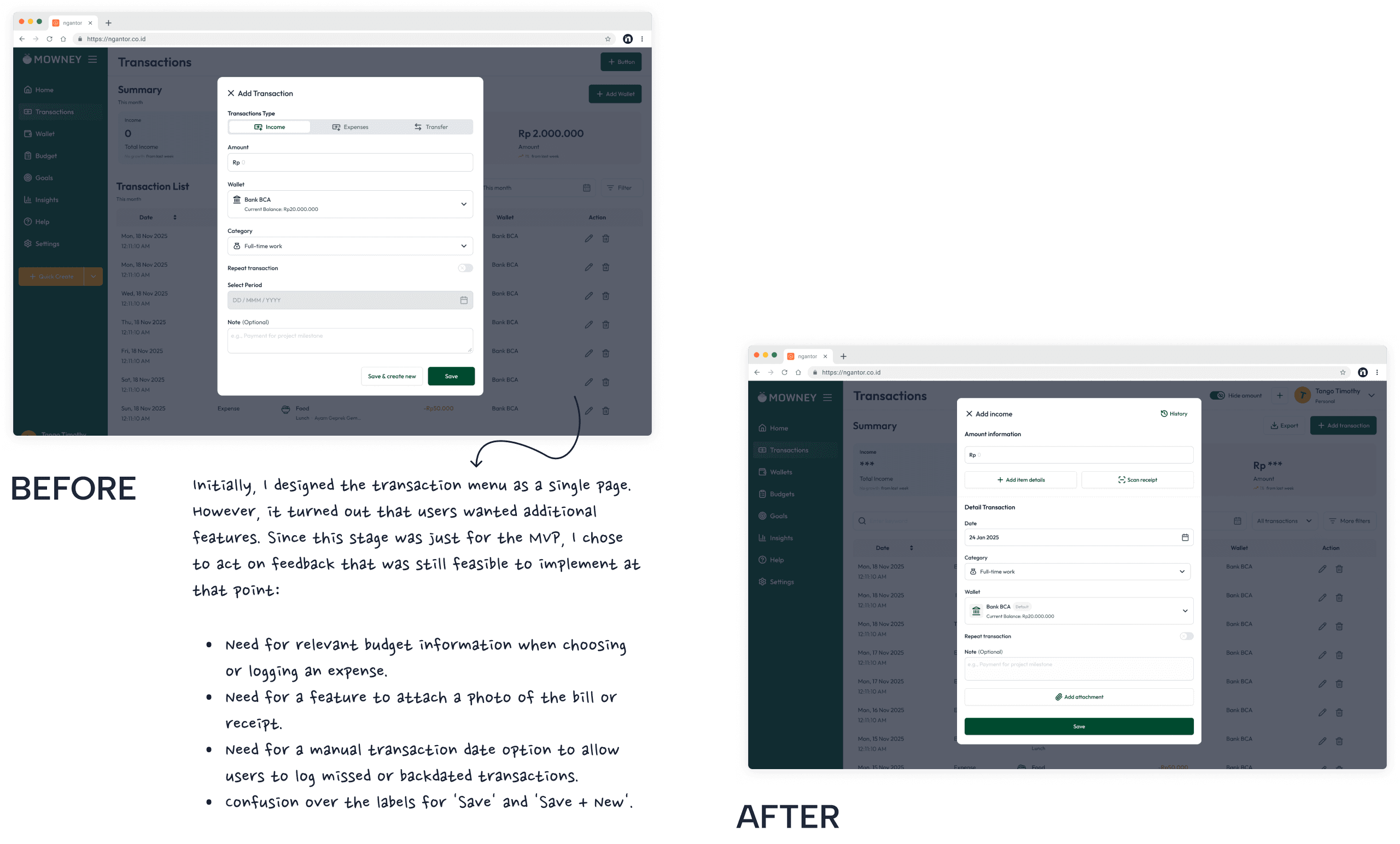
To improve the tracking experience, I added a scan and photo-upload feature, enabling users to record their financial data quickly.
To drive user retention and encourage habit-building, I implemented a gamified streak feature. The streak counter updates and displays once users log at least one transaction each day.

Budgeting
Through this feature, users can easily manage and maintain their regular budgets.

Wallet
Since I know it isn't easy to handle compliance within a financial product, I thought it would be unfeasible to integrate with a third party at the initial stage. On the other hand, I wanted to keep this feature since it is considered one of the core features.

MOBILE VERSION
